
First-person shooter (FPS) games demand sharp reflexes and pinpoint accuracy. Whether you're competing in fast-paced online matches or trying to clear difficult single-player levels, improving your aiming skills can make all the difference.
Fortunately, with the right techniques, training, and equipment, you can boost your accuracy and reaction speed.
Train your aim with practice routines
Aiming is a skill, and like any skill it responds to consistent, focused repetition. Most major FPS title - Call of Duty, Counter-Strike 2, and Valorant - offer offline bot matches, or dedicated training modes. Use them. Playing against bots removes the pressure of live opponents and lets you work on technique rather than just surviving.
Start slower than feels necessary. Deliberate, controlled movements build cleaner muscle memory than frantic ones. Increase speed gradually as accuracy becomes consistent. The goal is to make precise aim feel automatic - something your hands do without your brain having to manage it consciously.
Sort out your thumbsticks
This is the most overlooked upgrade most controller players can make, and one of the most impactful.
Stock thumbsticks are designed to work across every genre - platformers, driving games, RPGs, shooters. That breadth means they're optimised for nothing in particular. In an FPS, where your thumbsticks are responsible for every movement decision and every shot, that compromise shows up.
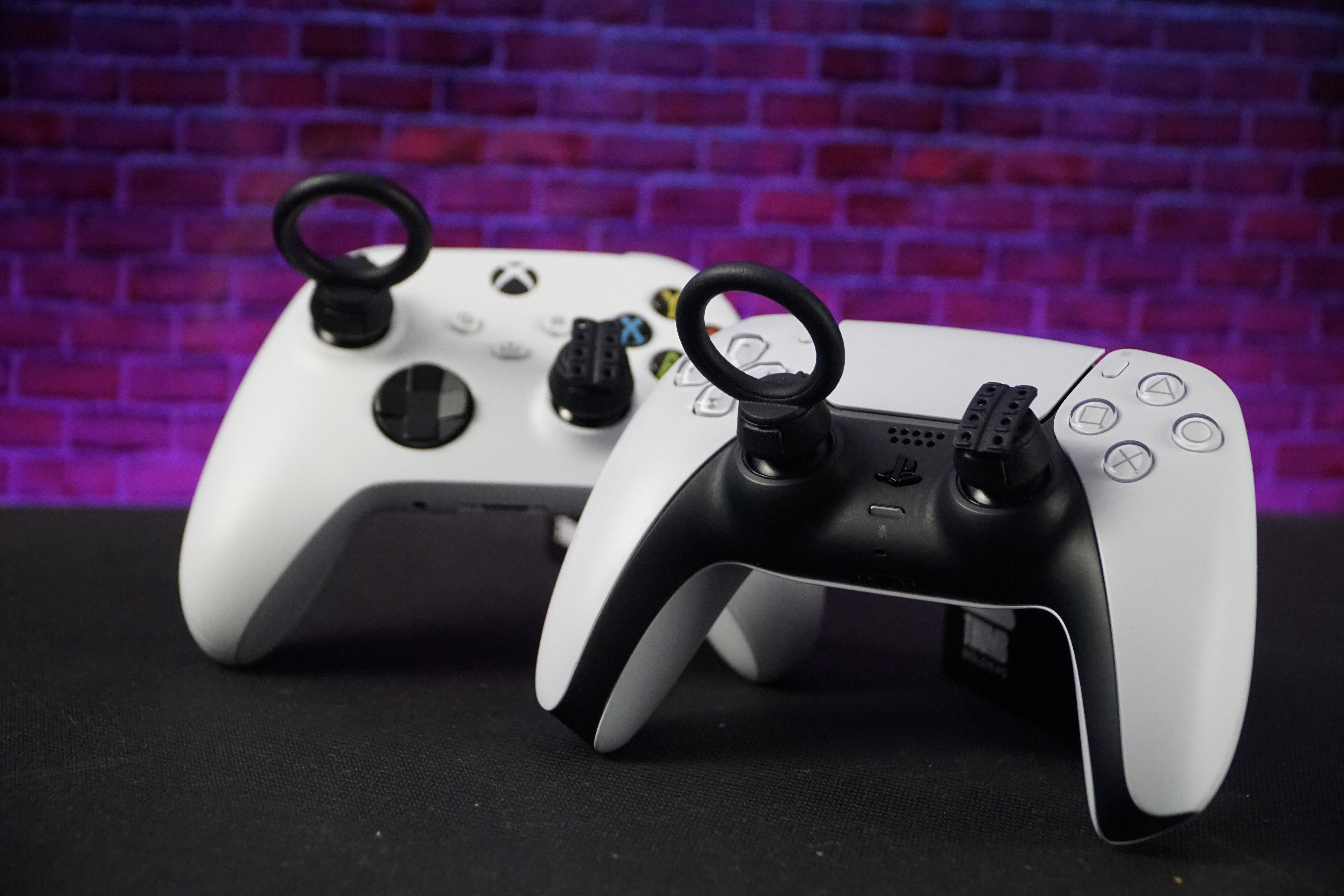
The Shooter Kit addresses this with two attachments built specifically for FPS play - one for each stick, each solving a different problem.
Left stick — Studs
Your left stick handles all player movement: positioning, strafing, rotating, pre-aiming corners. It's in constant use and under constant pressure. The problem with a smooth stock surface is that your thumb moves with it — small shifts accumulate, your grip loses its place, and your movement becomes approximate without you realising it.
Studs replaces that surface with a raised, textured pattern that gives your thumb a consistent anchor point. The studs act as tactile reference points — your thumb finds them automatically, even mid-fight. You stop unconsciously correcting your grip and start moving with intention. Strafes feel tighter. Positioning feels deliberate.
Right stick — Step Up
Aim is where matches are decided, and your right stick is entirely responsible for it. The core challenge is that fast target acquisition and precision micro-adjustment pull against each other — speed costs control, control costs speed. Stock thumbsticks force a fixed compromise between the two.
Step Up removes that trade-off with a dual-level design: a lower contact surface for fast tracking and reactive movement, and a raised upper level for precision aim. The physics behind it is straightforward — the further your contact point sits from the fulcrum, the more control you have over small inputs, in the same way a longer wrench gives you more control over a tight bolt. Drop to the lower level to snap onto a target or chase movement. Engage the upper level when the shot needs to land clean. Switch between them instantly, without tools, without interrupting play.
Once you adjust to switching on the fly, going back to a fixed-height stick feels like a genuine handicap.
Adjust your sensitivity settings
Finding the right sensitivity is crucial for accuracy. A lower sensitivity allows for more precise aiming, while a higher sensitivity enables quicker reactions. Many professional players use a relatively low sensitivity setting, allowing for controlled, accurate movements.
If you play with a controller, tweaking the aim acceleration and dead zone settings can also improve responsiveness. Experiment with different settings until you find a balance that suits your playstyle.
Use a monitor that keeps up
Reflexes are only as fast as what you can see. A monitor running at 120Hz or higher displays more frames per second, which makes motion appear smoother and reduces the input lag between your action and the visual feedback. If you're playing a fast-paced FPS on a 60Hz display, you're working with a ceiling that your reflexes have already outgrown.
Improve your movement mechanics
In FPS games, movement is just as important as aiming - sometime more so. Strafing, crouch-shooting, and jump-peeking can throw off opponents' aim while keeping you mobile. Practising these mechanics can help you stay one step ahead of your enemies.
Try incorporating movement drills into your routine by engaging in 1v1 duels, custom games, or movement-based challenges in your game’s training mode. Games like Rainbow Six Siege and Apex Legends heavily reward movement precision, making practice essential for success. Combining smooth movement with sharp aiming will make you a much harder target to hit.
Holding your controller
Grip affects everything — button access, reaction time, how long you can play before fatigue sets in. There's no single correct grip for controller players, but it's worth experimenting. A claw grip, for example, keeps fingers closer to the face buttons, which can meaningfully reduce the time between seeing something and responding to it.
Whatever grip you use, make sure your thumbs aren't working harder than they need to. Good equipment reduces the friction — and the Shooter Kit's textured surfaces mean less compensating, more playing.
Stay composed when it counts
Accuracy degrades under pressure — that's not a skill problem, it's human. Panic leads to rushed inputs, overcorrection, and shots that miss targets you'd hit in a calmer moment.
A few things help. Keep your crosshair at head height and pre-aim common angles — this reduces the adjustment required when an opponent appears. Watch your own replays without ego and look for patterns in where things go wrong. And practise the high-pressure scenarios specifically: running custom games that recreate the situations where you know you lose composure is more valuable than general play.
The more your mechanics become automatic — aim, movement, grip — the less mental load each firefight carries. That's where composure actually comes from.
Putting it together
Improving at FPS games is a compounding process. Better settings reduce friction. Better mechanics build confidence. Better equipment means your inputs actually reflect your intentions — which is what makes the rest of the work worthwhile.
The Thumb Soldiers Shooter Kit is a focused starting point: two attachments, two sticks, two distinct problems solved. If your thumbsticks are the weakest part of your setup, that's the most efficient place to start.


